Monaco Energy Boat Challenge

Edit Content

2026 AI Class Participants

#Energyboatchallenge

participants 2026

Edit Content

ADRIA AUTONOMOUS BOAT

Association of Applied Technical Sciences

adria

TEAM

Our team is a multidisciplinary group of students and engineers united by a shared passion for advancing autonomous maritime systems. We bring together expertise in mechanical design, software development, and electrical engineering, allowing us to approach challenges from multiple perspectives. By combining mechanical innovation, intelligent algorithms, and reliable electrical and electronic systems, we aim to make a meaningful contribution to vessel autonomy, promote sustainable marine technologies, and develop environmentally conscious solutions for a wide range of maritime applications and operations.

Project

Our project focuses on developing an eco-friendly autonomous vessel that combines advanced sensing, control, and decision-making systems. By integrating artificial intelligence, LiDAR, sensors, and real-time data processing, the vessel can navigate safely and independently in complex and dynamic marine environments. It is powered by two electric motors in a differential setup, which increases propulsion efficiency and manoeuvrability while minimising environmental impact. Beyond its current capabilities, the vessel is designed with future potential in mind. It can support marine research, environmental monitoring, and ecosystem protection, while offering a platform that could be adapted for a wide range of scientific, commercial, and environmental applications.
Edit Content

AGH SOLAR BOAT

AGH University of Kraków
agh

TEAM

AGH Solar Boat is a team of approximately 100 engineering students representing nearly every faculty at our university. We focus on designing and building solar-powered and autonomous boats. We have been competing in the Monaco Energy Boat Challenge since 2017, initially in the Solar Class and currently in the AI Class.

Project

Celka, a solar boat turned autonomous, is a 6-metre-long boat designed and built by members of AGH Solar Boat team. Originally designed as a manned solar racing boat, it has been retrofitted into an autonomous surface vehicle (ASV). The vessel features a lightweight carbon fibre composite hull and a custom electric propulsion system. Its autonomous capabilities rely on a sensor array that includes LiDAR, stereovision camera and high-precision GPS. These sensors feed data into onboard computers running neural networks, allowing the boat to map its surroundings, detect obstacles, and plan paths.
Edit Content

FEUP ACADEMIC SOLAR TEAM

Faculdade de Engenharia da Universidade do Porto
feup

TEAM

The FAST project, led by students at FEUP, combines our passion for Naval Engineering with a commitment to sustainability. Our goal is to develop and build a vessel powered entirely by solar energy, demonstrating that the naval industry can embrace greener practices. Our motto, ‘Towards a greener blue’, reflects our vision of a more sustainable maritime future.

Project

Atlântico is the team’s first prototype, and it’s a groundbreaking vessel. As the first of its class to have a hull entirely made from flax fibre, it reflects our commitment to sustainable materials. The prototype incorporates a T-shaped hydrofoil system, enhancing both speed and autonomy. Designed with one clear goal: to prove that sustainability and competitiveness can go hand in hand!
Edit Content

POWERGOATS

Poznan University of Technology
powergoats

TEAM

POWERgoats is a team of POWERboat designers from the PUT Powertrain Interfaculty Scientific Club. We conduct research every day and design of alternative drive systems used in various means of transport. We deal with three main activities in the Science Club projects, including constructing a dynamometer for an unmanned aircraft, organising the Motorboat Technology Symposium, and being engineers of the future by constructing a solar boat.

Project

Solar boat – POWERboat. This is our flagship project for 2024-26, it combines photovoltaic panels and fuel cells with advanced solutions for energy management, storage, and conversion, to participate in the Monaco Energy Challenge. The project develops solutions for all our centres (mechanics, electronics, IT, products, marketing, and sales products). The design of POWERboat is based on optimisation of hydrodynamic resistance using hydrofoils and a hidden cockpit made of basalt material, which in the future may be utilised throughout the boat. It also introduces energy over time and adaptive powertrain operating modes that optimise energy performance. With a photovoltaic system with active cells monitoring energy production, detecting irregularities both in port and during the cruise. Our goal is to show ourselves as engineers of the future.
siyahamba
Edit Content

SIYAHAMBA

Durban University of Technology

TEAM

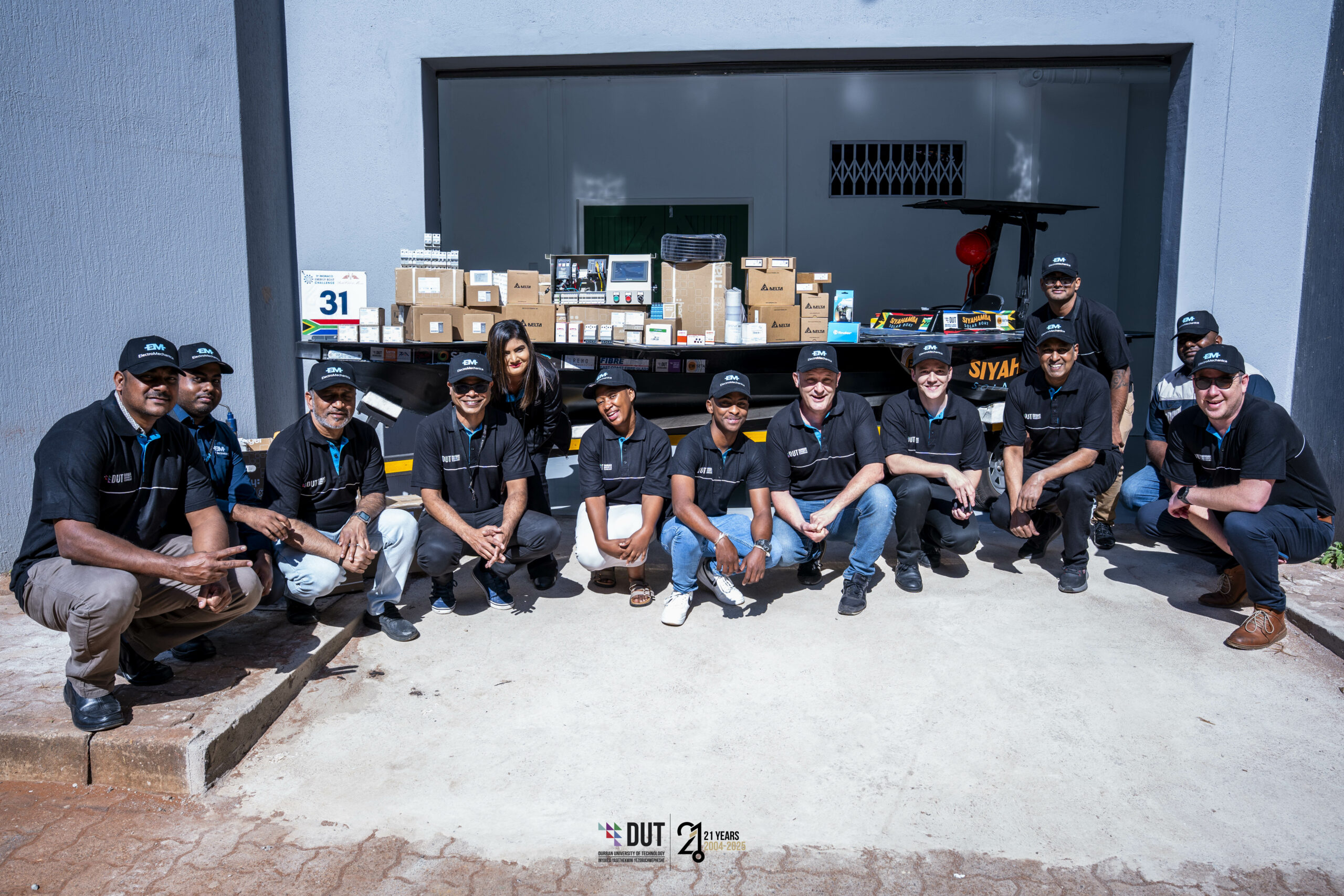
The SiyaHamba Boat Team is based at the Physics Department in the Faculty of Applied Sciences at the Durban University of Technology. It assists SMEs and industrial clients in research and development and the prototyping of innovative products, energy auditing and measurement and verification of implemented energy saving initiatives within the energy sector. This unit was created to respond to the need for awareness, innovation, development, empowerment, entrepreneurship, research and technology transfer in energy efficiency and sustainable energy in KwaZulu-Natal.

Project

The SiyaHamba AI boat will be developed from the existing solar PV boat that successfully participated in the 2024 event, with targeted modifications to the deck and cockpit to integrate advanced AI technologies and supporting infrastructure. The project aims to deliver a fully functional, AI-operated vessel, representing a first-of-its-kind achievement for the institution. Key objectives include engaging and inspiring both students and staff to participate in this emerging technological field, while producing a competitive racing boat for all event races. The system will include two GPS units, four LIDAR sensors (mounted at the bow and stern), two position sensors, one positioning actuator, and two speed sensors. These components will interface with an AI-based navigation and management system, which will communicate with a PLC drive unit via an RS485 bus to control speed and positioning actuators. It will integrate an HMI, LED dashboard, wireless data communication module for monitoring and control.
Edit Content

TAMEO AI

École nationale supérieure de techniques avancées Paris
Tameo_IA

TEAM

Taméo ENSTA enters its 5th participation in the Monaco Energy Boat Challenge with the same energy and passion that have driven the team since its creation. Every year, we welcome many new members eager to innovate and take on ambitious technical challenges. We are committed to passing on the experience gained in previous editions, sharing our skills, and upholding the values that define Taméo: teamwork, creativity, technical excellence, and a strong commitment to sustainable navigation.

Project

Following two years of developing and refining onboard AI navigation systems, the Taméo ENSTA team is ready to take a major step forward by entering the AI Class at this year’s Monaco Energy Boat Challenge. Building on extensive testing, iterative improvements, and real-world trials, we now feel confident in the maturity and reliability of our algorithms. This season, our goal is clear to bring the project to full fruition by demonstrating a fast, precise, and autonomous boat capable of handling complex navigation tasks. We are enhancing our sensor suite, optimising data-processing pipelines, and improving decision-making models to ensure robust performance in every race condition. Driven by determination and innovation, the team is eager to showcase the progress made and compete at the highest level in the AI Class.
Edit Content

TÉCNICO SOLAR BOAT

Instituto Superior Técnico
TSB_Team

TEAM

Técnico Solar Boat (TSB) is a student-led project dedicated to the design and manufacture of sustainable and autonomous vessels. With over a decade of history and a fleet of seven boats, TSB is defined by its ambition and multidisciplinary expertise, pioneering technologies in solar energy, hydrogen propulsion, hydro foiling, and autonomous systems. Currently, the team is consolidating its cumulative knowledge into its most advanced prototype to date: São Gabriel 01. This vessel represents TSB’s most ambitious challenge, integrating years of innovation into a single, high-performance platform.

Project

This year, Técnico Solar Boat aims to build upon the previous season’s foundations by refining São Gabriel’s existing systems while integrating cutting-edge technologies. The most significant advancements focus on hydrogen propulsion and full autonomy. The team is currently engineering the integration of a 100kW fuel cell to demonstrate hydrogen’s potential as the definitive energy source for the future of maritime transport. Simultaneously, the development of a steer-by-wire system is underway to achieve full vessel autonomy, ensuring the prototype is prepared to meet the complex technological challenges of tomorrow.
Edit Content

TGM SOLAR BOAT TEAM

Technologisches Gewerbemuseum Institute of Technology
8. TGM SOLAR BOAT TEAM

TEAM

From the Technologisches Gewerbemuseum Institute of Technology, the Department of Information Technology and the Department of Mechanical Engineering are jointly participating in the Monaco Energy Boat Challenge. The Department of Information Technology contributes three specialised project groups, each focusing on the development of artificial intelligence (AI) models addressing distinct aspects of autonomous vessel operation for one of the races. The Department of Mechanical Engineering is responsible for the design and fabrication of the vessel’s hull, with particular attention to hydrodynamic optimisation and energy efficiency, as well as the development of the steering mechanism to support accurate and reliable manoeuvring. All subprojects are carried out by students as part of their diploma theses.

Project

To find the appropriate course through the buoys for the different races machine learning and neural networks will be integrated into Unity via the Unity Inference Engine, at least for the purpose of object detection from the camera feed. To simulate the boat in the water in Unity, the Dynamic Water Physics package is used. So far, we know that we will need to train our own object detection model specifically for buoys. The development approach for the actual control AI, the component responsible for generating propulsion and steering commands for the boat based on the detected objects has not yet been determined. It is possible that the team will train a neural network for this purpose, although a symbolic AI (an explicitly programmed decision logic rather than a learned model) might also be more appropriate.
9. UANTWERP SOLAR BOAT TEAM
Edit Content

UANTWERP SOLAR BOAT TEAM

University of Antwerp

TEAM

The UAntwerp Solar Boat Team is a group of bachelors and masters students from the Faculty of Applied Engineering at the University of Antwerp. Each year, the team designs and builds a solar-powered racing boat to compete in international competitions. This demanding environment pushes the team to innovate in efficient, sustainable energy use. In recent years, the team has focused strongly on autonomous sailing. By developing a fully electronic steer-by-wire system, AI-powered object detection, and intelligent pathfinding algorithms, supported by a new suite of sensors, they significantly enhanced the boat’s situational awareness and precision.

Project

The project’s main innovations focus on autonomy, perception, and performance. A complete overhaul of the navigation and perception architecture led to the development of a fully custom, ROS2-based navigation stack, designed specifically for high-precision autonomous sailing in dynamic and competitive environments. In parallel, the team introduced a 360° stereovision, AI-driven perception system that significantly enhances environmental awareness. By combining advanced computer vision with real-time sensor fusion, the boat can accurately detect obstacles, recognise course elements, and respond intelligently during autonomous manoeuvres. Redesigns to the boat’s structure and driveline improved peak performance, efficiency, and reliability, ensuring that the platform fully supports the increased demands of high-speed, autonomous operation.
10. UGENT SAILING
Edit Content

UGENT SAILING

Ghent University

TEAM

UGent Sailing is organised into several focused sub teams: Construction, Electrical, Energy, Design, and Autonomous. This structure allows everyone to contribute where their strengths lie, while still collaborating closely on one shared project. In addition to the core teams, we work with volunteers who contribute whenever their schedule allows, making the team flexible and accessible for students with varying backgrounds and availabilities. Moreover, organisational teams handle sponsorship relations, finances, communication, and the website. Together, we form a highly motivated and collaborative group, driven by enthusiasm, shared responsibility, and the ambition for this project.

Project

Our project focuses on the design and development of an energy-efficient electric boat with a strong emphasis on innovation and autonomy. As we are participating in the AI-class this year, a key aspect of our work is the integration of an AI-driven autonomous system in our boat. This allows students to do research to state-of-the-art machine learning and control techniques for in a real-world maritime context. The boat combines efficient hull design, optimised energy management, and intelligent onboard electronics to maximise performance while minimising energy consumption. Our main objective is not only to perform competitively in the Monaco Energy Boat Challenge, but also to create a practical learning platform where students can experiment with sustainable propulsion, autonomous navigation, and smart decision-making systems. Through this project, we aim to bridge theory and practice and contribute to the future of clean and intelligent maritime transport.
Edit Content

WANNSEA

Technische Universität Berlin

TEAM

We are a team of students from various degree programs at TU Berlin. Together, we are developing a boat based on sustainable propulsion methods. We plan to participate in the Monaco Energy Boat Challenge again this year in July 2026 in both the Energy Class and AI class. Sustainability has rarely been a consideration in boatbuilding. We want to change that! We are committed to using recycled and alternative building materials such as natural fibres and eco-friendly fibre composites, not only to protect the environment but also to increase the boat’s lightness.

Project

Our work combines innovative propulsion technologies with environmentally responsible boatbuilding. We design and build vessels using recycled and bio‑based materials such as natural fibres and ecological composites to reduce environmental impact while improving structural performance. We are developing autonomous navigation capabilities using radar, lidar, GPS, cameras, and AI to enable safe, efficient, and fully automated operation. Our goals are to advance zero‑emission propulsion, promote recyclable construction methods, integrate intelligent navigation systems, and demonstrate that sustainable maritime innovation can deliver both high performance and real environmental impact. As a new material, we want to try to implement mycelium on our boat.